

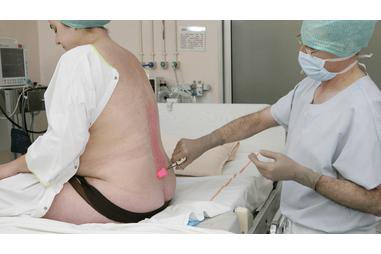
An epidural is a procedure that injects by Anesthesiologist in to the space around the spinal nerves in your lower back.
This anaesthetic usually blocks the pain from labour contractions and during the birth very effectively. With an epidural you can usually move and can push your baby out when you need to.
The procedure
Before an epidural, you will usually have a drip for fluids put into your arm.
🚩You can sit up and bend forward over a pillow, or lie on your side curled up into a ball. This makes it easier for the needle to be inserted into the right place. You will be asked to stay still.
🚩Your lower back will be washed with cold antiseptic. A small amount of local anaesthetic will be injected into the skin of your lower back.
🚩A needle will be inserted between the bones of your spine into the space around your spinal nerves.
🚩Your anaesthetist will insert the epidural needle when your contraction stops, so it is important that you tell them when you have a contraction.
🚩A small soft plastic tube will be inserted and the needle will be removed. That tube delivers the anaesthetic that will numb your pain.
It usually takes between 5 and 30 minutes for your pain to be relieved by the epidural.
You usually only have an epidural during the first stage of labour – but it can be given at any stage of labour.
Advantages and disadvantages of an epidural
Epidurals are available at Hospitals but not in birth center or for home birth.
The advantages of an epidural are:
🚩it is usually very effective
🚩it is generally very safey
🚩you can often still move around and push when you need to.f
🚩if you’re having a CS you can stay awake and your partner can be there
The disadvantages of an epidural are:
🚩for medical reasons, not everyone can have an epidural
🚩you might need to have fluids given to you through a tube in your arm, and will need to have your blood pressure monitored
🚩you might lose feeling in your bladder and need a catheter (tube) in your bladder to help you pass urine
🚩you might lose feeling in your legs for a few hours
🚩it might slow down the second stage of labour
🚩you might not be able to push and need help to give birth
🚩your baby will need to be closely monitored during your labour
Risks and side effects
An epidural is effective and fairly safe. But there are some risks.
Some women feel cold or itchy.
A small number of women get little or no pain relief.
Some women get weakness in the legs; it wears off after a few hours.
There is an increased risk of needing forceps or vacuum to help with the birth.
Some women develop a bad headache 24 to 48 hours after an epidural.
There is a small chance of developing a skin infection.
Very rarely a few women get permanent nerve damage.
What to discuss with your doctor or midwife
You can check:
if you can have an epidural at your chosen hospital or birth centre
what their epidural procedures are
the type of pain relief that might suit you best
 Modern Momma Ph
One more important aspect is that if you are a senior citizen, travel insurance pertaining to pensioners is something you ought to really consider. The more aged you are, greater at risk you might be for getting something terrible happen to you while overseas. If you are definitely not covered by some comprehensive insurance, you could have a few serious challenges. Thanks for expressing your advice on this blog site.
LikeLike
Thanks for your whole efforts on this blog. Kate enjoys making time for investigations and it’s really obvious why. My spouse and i learn all of the lively manner you create priceless tips by means of this website and in addition strongly encourage contribution from the others on this content and our favorite princess is in fact learning a whole lot. Have fun with the rest of the year. You are carrying out a fabulous job.
LikeLike
hey all, I was simply checkin’ out this blog and I actually admire the premise of the article, and don’t have anything to do, so if anybody wish to to have an engrossing convo about it, please contact me on AIM, my name is heather smith
LikeLike
What is great respecting is dealing with instead of depending on.
LikeLike